Oregon Landlord-Tenant Law: ORS 90.322, 90.323 & 90.360
Reading this because of your own Oregon lease?
Upload it and the AI checks it against Oregon rules in about 2 minutes — free, no credit card.
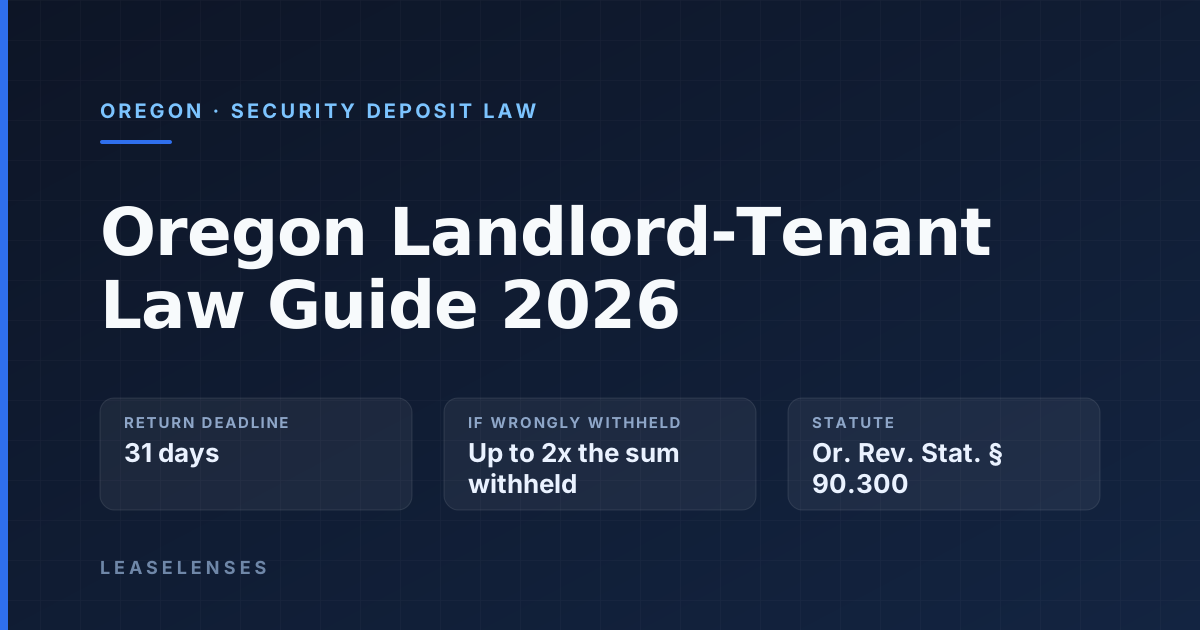
Oregon rental law is unusually specific. A lease that looks normal in another state can create real exposure in Oregon if it uses the wrong rent increase language, skips deposit accounting details, overstates entry rights, or relies on an outdated nonpayment notice timeline.
For 2026, the highest-conversion Oregon questions are practical:
- Can this lease support a rent increase under Oregon's 2026 cap?
- Does the deposit clause match the 31-day accounting rule?
- Can the landlord enter with less than 24 hours' notice?
- Are repair, essential-service, and minor-defect remedies described correctly?
- Does the eviction notice clause confuse 10-day, 13-day, 30-day, 90-day, and 24-hour notices?
This guide summarizes the clauses Oregon landlords, tenants, and property managers should check before signing or enforcing a residential lease. It is an educational overview, not legal advice.
Upload your Oregon lease to LeaseLenses to flag rent increase, deposit, entry, repair, renewal, and eviction-notice clauses against the issues below.
Quick Oregon Rules for 2026
| Issue | Oregon rule to check | Why it matters in the lease |
|---|---|---|
| 2026 rent cap | For covered tenancies, Oregon DAS published a 9.5% maximum annual rent increase for 2026 | A generic "market rent" increase clause can be too broad |
| Rent increase notice | Most non-week-to-week tenancies need at least 90 days' written notice after the first year | Shorter notice language can make an increase defective |
| First year of tenancy | Rent generally cannot be increased during the first year, except week-to-week rules | Many form leases omit this restriction |
| Security deposit return | Deposit accounting or refund is due within 31 days after termination and delivery of possession | The lease should not give the landlord a longer window |
| Deposit deductions | Deductions must be tied to defaults, unpaid rent, and tenant-caused damage beyond ordinary wear | Broad "any cost" deduction language is risky |
| Entry notice | In ordinary cases, at least 24 hours' actual notice and reasonable timing are required | Lease language allowing entry "at any time" is a red flag |
| Essential services | Tenants may pursue substitute services, rent diminution, substitute housing, or 48-hour termination in serious cases | Repair clauses should not waive statutory remedies |
| Minor repair-and-deduct | ORS 90.368 covers minor habitability defects up to $300 after proper written notice | A lease should not ban every repair-and-deduct remedy |
| Nonpayment notice | For most tenancies, nonpayment can use a 10-day notice served no sooner than the 8th day, or a 13-day notice served no sooner than the 5th day | Old "72-hour" templates can be wrong outside week-to-week tenancies |
| After first year termination | Month-to-month termination by landlord generally needs tenant cause or a qualifying landlord reason | Old no-cause termination clauses can mislead both sides |
Oregon Rent Increase Law in 2026
Oregon's statewide rent stabilization rules are centered on ORS 90.323 and ORS 90.324. For most non-week-to-week residential tenancies:
- Rent generally cannot be increased during the first year of the tenancy.
- After the first year, the landlord must give at least 90 days' written notice.
- Rent may not be increased more than once in a 12-month period.
- For covered tenancies, the annual increase cannot exceed the maximum percentage calculated for that calendar year.
For calendar year 2026, the Oregon Department of Administrative Services published the maximum annual rent increase percentage for ORS 90.323 tenancies as 9.5%.
What Oregon Lease Clauses Should Say About Rent Increases
A stronger Oregon lease does not just say "rent may increase as allowed by law." It should be clear enough to prevent the most common disputes:
- No rent increase during the first year for covered non-week-to-week tenancies.
- At least 90 days' written notice for covered non-week-to-week tenancies after the first year.
- No more than one increase in a 12-month period.
- A statement that increases above the cap require a valid statutory exemption.
- The notice must identify the amount of the increase, new rent, effective date, and exemption facts if the landlord claims an exemption.
Common Oregon Rent Cap Mistakes
Watch for these clauses:
- "Landlord may increase rent upon 30 days' notice."
- "Rent may increase at market rate at renewal."
- "Tenant waives any rent control or rent stabilization protection."
- "Landlord may increase rent more than once per year."
- "New rent applies automatically unless tenant objects."
Those clauses may be harmless in some leases if superseded by law, but they are exactly the kind of language that creates confusion and weakens enforcement.
Oregon Security Deposit Law
Oregon security deposit rules are primarily in ORS 90.300. The state does not set a simple statewide dollar cap for ordinary residential security deposits, but it heavily regulates receipts, accounting, permitted deductions, and return timing.
The 31-Day Deposit Accounting Rule
Within 31 days after the tenancy terminates and the tenant delivers possession, the landlord must either:
- return the security deposit or prepaid rent that is not claimed, or
- provide a written accounting stating the specific basis for each claimed deduction.
If the landlord fails to comply, or acts in bad faith, the tenant may be able to recover twice the amount withheld without proper accounting or withheld in bad faith.
Permitted Oregon Deposit Deductions
Oregon landlords may claim only amounts reasonably necessary for permitted purposes, including:
- unpaid rent or other tenant defaults under the rental agreement;
- tenant-caused damage to the premises, excluding ordinary wear and tear;
- reasonable cleaning or repair labor when allowed by the statute and lease facts;
- specific carpet cleaning costs only when the statutory conditions are met.
A lease clause that lets the landlord deduct for "any cost, fee, or inconvenience" is too loose. The better clause ties deductions to ORS 90.300 categories and requires itemized accounting.
Free check · no account, no card
Check this against your own lease
This guide covers Oregon's rules. The free check tells you which ones your lease actually meets, misses, or waives. Paste the clause here and keep reading — the verdict appears on this page.
Skip full upload for now
Paste one clause and get the first free verdict.
Use the exact wording about deposit, repairs, entry, notice, renewal, fees, waiver, or move-out. We keep this article's state-law context, show a free clause verdict first, and ask for payment only if the Action Packet is useful.
What the free verdict includes
Free verdict includes
What to paste
Paid packet adds
Exact clause proof · Preferred, fallback, and minimum wording · Likely reply, evidence to keep, deadline radar, and PDF export
Have the lease open?
Copy 2-6 sentences from the clause into the box. No file or card is needed for the first verdict.
Habitability and Repairs in Oregon
ORS 90.320 requires landlords to maintain the dwelling unit in habitable condition. That includes weather protection, plumbing, hot and cold running water, heating, electrical systems, safe common areas, garbage receptacles, floors and railings, supplied appliances, smoke alarms, carbon monoxide alarms where required, and working entrance locks.
Tenant Repair Remedies
Oregon repair remedies are not one-size-fits-all. A lease should not flatten them into a vague "tenant may repair and deduct" or "tenant may never repair and deduct" clause.
Key Oregon repair paths include:
- General landlord noncompliance: ORS 90.360 lets a tenant give written notice and, depending on the breach, seek termination, damages, or injunctive relief.
- Essential services: ORS 90.365 addresses intentional or negligent failure to supply essential services. After written notice and a reasonable opportunity, tenants may pursue substitute services, rent diminution, or substitute housing. If the lack of service poses an imminent and serious threat, a 48-hour termination notice may apply.
- Minor habitability defects: ORS 90.368 allows a tenant to cause repair of a minor habitability defect and deduct the actual and reasonable cost, up to $300, after written notice and at least seven days for the landlord to repair.
Repair Clauses That Deserve Review
Oregon lease review should flag clauses that:
- make the tenant responsible for all repairs, even conditions covered by ORS 90.320;
- waive habitability remedies;
- prohibit every rent deduction without acknowledging ORS 90.368;
- require tenant reimbursement for damage without distinguishing ordinary wear;
- let the landlord delay essential-service repairs indefinitely.
Oregon Landlord Entry Rules
ORS 90.322 gives Oregon landlords access for inspections, repairs, services, yard maintenance where agreed, and showings, but the right is limited.
In ordinary cases, the landlord must give at least 24 hours' actual notice and enter only at reasonable times. The tenant may deny consent in some circumstances. Emergency entry is different: the landlord may enter without prior consent or notice when there is a genuine emergency, but must give actual notice within 24 hours after entering in the tenant's absence.
Entry Clauses to Watch
Review the lease carefully if it says:
- "Landlord may enter at any time."
- "Tenant consents to all future entries."
- "No notice is required for inspection."
- "Tenant may not deny access under any circumstances."
- "Showing access is unlimited during the last 60 days."
Those phrases may conflict with Oregon's actual-notice and reasonable-time framework.
Oregon Eviction and Termination Notices
Oregon eviction rules are detailed, and many online lease templates are stale. Do not rely on a single generic "pay or quit" clause.
Nonpayment of Rent
ORS 90.394 sets different timing depending on tenancy type:
- Week-to-week tenancy: at least 72 hours' written notice, served no sooner than the fifth day of the rental period.
- Other tenancies: at least 10 days' written notice, served no sooner than the eighth day of the rental period; or at least 13 days' written notice, served no sooner than the fifth day of the rental period.
The notice must specify the amount of rent due and the date and time by which payment must be made to cure the nonpayment.
Material Lease Violations
Under ORS 90.392, cause-based termination generally requires written notice describing the violation. If the violation can be cured, the tenant usually gets at least 14 days to cure within a notice period of at least 30 days. For a substantially similar violation within the previous six months, the notice period can be shorter and there may be no right to cure.
After the First Year of Occupancy
ORS 90.427 sharply limits landlord termination without tenant cause after the first year. For month-to-month tenancies after the first year, the landlord generally needs either:
- tenant cause, using the appropriate statutory notice, or
- a qualifying landlord reason, usually with at least 90 days' notice and required supporting information.
Qualifying landlord reasons can include demolition, conversion to nonresidential use, repairs or renovations that make the unit unsafe or unfit during the work, owner or immediate family occupancy, or certain sales to an owner-occupant. Some relocation-payment requirements do not apply to landlords with ownership interests in four or fewer covered dwelling units.
Oregon Lease Clauses Most Worth Auditing
If your Oregon lease is more than a year old, copied from a national template, or reused across multiple states, focus on these clauses first:
- Rent increase clause: Does it mention the first-year restriction, 90-day notice, annual cap, one-in-12-month limit, and exemption facts?
- Security deposit clause: Does it require 31-day accounting and limit deductions to permitted categories?
- Entry clause: Does it respect 24-hour actual notice, reasonable timing, emergency rules, and tenant consent limits?
- Repair clause: Does it preserve habitability, essential-service, and minor-defect remedies?
- Late fee and nonpayment clause: Does it distinguish rent, late fees, utilities, and the correct notice timeline?
- Termination clause: Does it account for the first year of occupancy, fixed-term expiration, cause-based termination, and qualifying landlord reasons?
- Fee clause: Does it avoid broad, undefined, or punitive charges?
- Disclosure clause: Does it include required federal and Oregon-specific disclosures where applicable?
How LeaseLenses Helps With an Oregon Lease
LeaseLenses is useful when the question is not "what does Oregon law say in general?" but "what does this lease actually say, and what should I ask about before signing or enforcing it?"
When you upload an Oregon lease, the analysis can help you:
- extract rent, deposit, term, renewal, late fee, and notice language;
- flag clauses that look inconsistent with Oregon timing rules;
- identify missing or ambiguous deposit accounting language;
- surface entry and repair clauses that deserve closer review;
- produce a prioritized risk packet instead of a long undifferentiated checklist.
The free preview is meant to answer one question quickly: does this lease contain enough risk or ambiguity to justify unlocking the action packet? If it does, the paid packet gives clause-level explanations, source context, and action items.
Check your Oregon lease with LeaseLenses
Sources Checked
This guide was updated for 2026 using:
- Oregon DAS 2026 Rent Stabilization Percentages
- ORS 90.300 - Security deposits
- ORS 90.320 - Habitability
- ORS 90.322 - Landlord entry
- ORS 90.323 - Maximum rent increase
- ORS 90.360 - Landlord noncompliance
- ORS 90.365 - Essential services
- ORS 90.368 - Minor habitability defects
- ORS 90.392 - Termination for cause
- ORS 90.394 - Nonpayment of rent
- ORS 90.427 - Termination without tenant cause
Turn this guide into your lease gap checklist
Check your exact Oregon lease clauses against this guide
This guide explains the statewide rules. Choose your PDF or Word lease to preview deposit, fee, entry, repair, renewal, notice, and move-out clauses before you pay for the Action Packet.
The free check runs first — no credit card. You only ever pay if the findings are worth keeping.
Money, repair, notice, and move-out clauses to verify
A state guide explains the rule; a lease scan shows whether the document you are about to sign gives you a money, deadline, or rights problem.
- Security deposit, late fee, entry notice, and repair duties
- Missing disclosures, waiver language, and one-sided penalties
- State compliance warnings with copy-ready next steps to send or keep
Want the Oregon deadline emailed to you on the day it lands?
Tell us the day you moved out. We count the 31 days Or. Rev. Stat. § 90.300 allows and email you once, on the day the landlord runs out of time — with what you can do next.
No newsletter, no account. Your address is used for this one email.
Ready to check this guide against your own lease?
Sign in once, then choose your lease. The free preview shows whether deposit, fee, entry, repair, renewal, notice, or move-out clauses deserve attention; unlock exact clauses and copy-ready next steps from $9.99 only if it helps.