New Mexico Landlord-Tenant Law: Late Fees & 3-Day Notice
Reading this because of your own New Mexico lease?
Upload it and the AI checks it against New Mexico rules in about 2 minutes — free, no credit card.
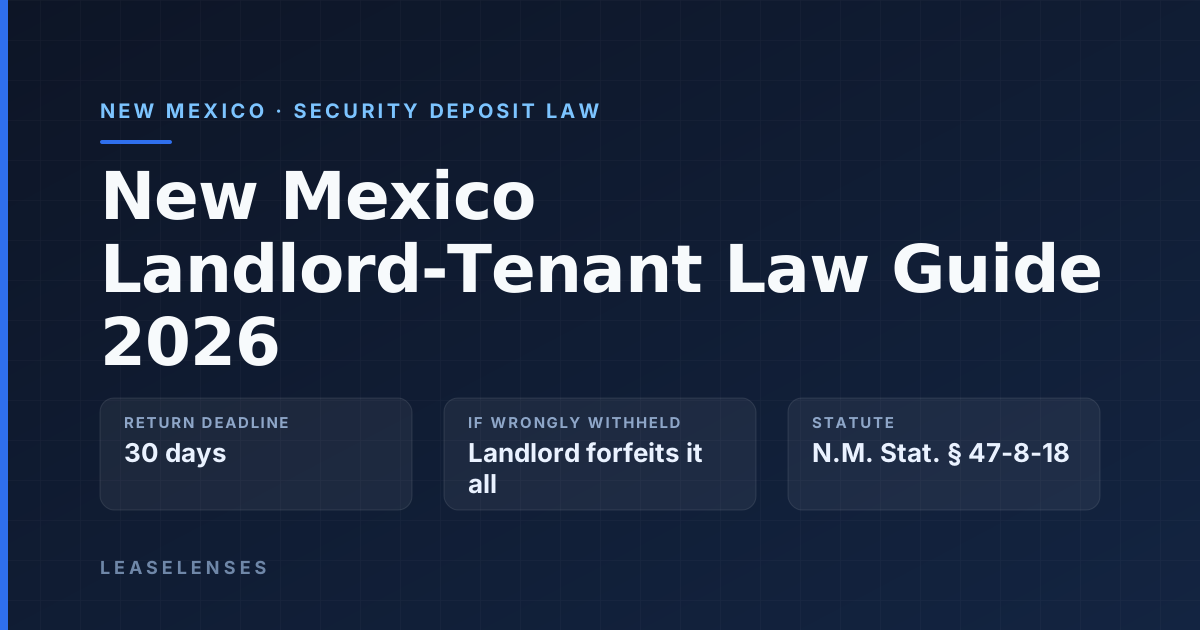
New Mexico landlord-tenant law is governed mainly by the Uniform Owner-Resident Relations Act. The statute uses the words owner and resident, but most leases still use "landlord" and "tenant." The practical review work is the same: read the lease against New Mexico Statutes Chapter 47, Article 8 before you sign, renew, withhold rent, keep a deposit, or serve a notice.
The clauses that usually matter most in a New Mexico lease are security deposits, late fees, entry notice, repair and rent-abatement procedure, rent increases, and eviction notices for nonpayment, material breach, and substantial violations.
Source note: this page is based on New Mexico Statutes §§47-8-15, 47-8-18, 47-8-20, 47-8-24, 47-8-27.1, 47-8-27.2, 47-8-33, 47-8-36, 47-8-37, and 47-8-39. It is general information, not legal advice.
If you are comparing these rules to a lease in front of you, upload your New Mexico lease to LeaseLenses. The free preview checks deposit, late-fee, entry, repair, renewal, and eviction-notice clauses before you decide whether to unlock exact clause locations and suggested wording.
Overview of the Uniform Owner-Resident Relations Act
The UORRA sets baseline rights and obligations for most residential rental agreements in New Mexico. It covers deposits, rent, owner obligations, resident obligations, entry, remedies, notices, possession actions, lockouts, and retaliation.
Key New Mexico Lease Review Points
- Deposits for rental agreements under one year are capped at one month's rent.
- Annual rental agreements may involve deposits above one month's rent, but interest rules apply.
- Deposit deductions and any balance are due within 30 days after termination or departure, whichever is later.
- Bad-faith deposit retention can trigger a $250 civil penalty.
- Late fees are capped at 5% of rent for the rental period and require timely notice.
- Ordinary entry generally requires 24 hours' written notification with purpose, date, and a reasonable time frame.
- Repair-related rent abatement requires written notice and seven days to remedy.
- Nonpayment uses a three-day notice; many other material breaches use seven days.
For additional disclosure context, see our landlord disclosure requirements guide.
New Mexico Security Deposit Law
Security deposits are controlled by New Mexico Statutes §47-8-18. This is one of the most important places to avoid generic lease language.
Deposit Limit Depends on Lease Term
For a rental agreement with a duration less than one year, the owner may not demand or receive a deposit greater than one month's rent.
For an annual rental agreement, the statute does not use the same one-month cap. If the owner demands or receives a deposit greater than one month's rent, the owner must pay the resident annual interest equal to the passbook interest permitted to savings and loan associations in New Mexico by the federal home loan bank board.
Practical lease review point: a New Mexico lease should not simply say "security deposit may be any amount" or "all leases are capped at one month." The correct clause depends on the lease term and whether interest is required.
Prepaid Rent Is Different
Section 47-8-18 says the deposit rule is not intended to include last month's prepaid rent required by the rental agreement. That means a lease should clearly separate:
- Refundable security deposit
- Last month's prepaid rent
- Nonrefundable fees
- Utility or service deposits
- Pet fees or pet deposits
If the same payment is described in multiple ways, the clause deserves review.
30-Day Return and Itemization Rule
After the residency ends, the owner may apply deposit money to unpaid rent, damages caused by the resident's noncompliance, repair work, utilities, or other legitimate damages. The owner may not retain a deposit for normal wear and tear.
If actual cause exists to retain any portion, the owner must provide an itemized written list of deductions and the balance, if any, within 30 days of the termination of the rental agreement or resident departure, whichever is later. Mailing the statement and payment to the resident's last known address is treated as compliance.
Consequences of Missing the Deadline
If the owner fails to provide the written deduction statement and balance due within the statutory deadline, §47-8-18(D) says the owner:
- Forfeits the right to withhold any portion of the deposit
- Forfeits the right to assert any counterclaim in an action brought to recover that deposit
- Is liable for court costs and reasonable attorney's fees
- Forfeits the right to bring an independent action against the resident for rental-property damages
If the owner retains a deposit in bad faith, §47-8-18(E) adds a $250 civil penalty payable to the resident.
Rent, Late Fees, and Rent Increases
New Mexico Statutes §47-8-15 controls several money clauses that often get copied incorrectly.
Late Fees Are Capped at 5% of Rent
If the rental agreement allows a late fee and the resident does not pay rent as agreed, the owner may charge a late fee of no more than 5% of the rent for each rental period in default. The late fee must be calculated only on rent, not deposits, utilities, or extra fees.
To assess the late fee, the owner must provide notice of the late fee charged no later than the last day of the next rental period immediately following the period in which the default occurred.
Practical lease review point: a New Mexico clause that says 10% late fee, daily compounding late fees, or late fees calculated on utilities and add-on charges should be flagged.
Rent Increase Notice
For a month-to-month residency, an owner may increase rent by giving written notice at least 30 days before the periodic rental date specified in the rental agreement. For a fixed-term residency, written notice must be given at least 30 days before the end of the term. For a periodic residency shorter than one month, written notice must be provided at least one rental period before the first increased payment.
New Mexico does not have statewide rent control for ordinary private rentals, but the notice timing still matters.
Owner Repair Duties and Resident Remedies
Owner Obligations Under §47-8-20
New Mexico owners must substantially comply with applicable minimum housing codes materially affecting health and safety, make repairs necessary to keep the premises safe, keep common areas safe, maintain supplied electrical, plumbing, sanitary, heating, ventilating, air-conditioning, and other facilities, provide waste receptacles and removal, and supply running water, reasonable hot water, and reasonable heat unless a statutory exception applies.
The owner must also provide a written rental agreement before occupancy begins.
Written Notice and Seven-Day Remedy Period
Under §47-8-27.1, when the owner fails to perform required obligations, the resident must give written notice specifying the breach. For material noncompliance with the rental agreement or noncompliance materially affecting health and safety, the notice states that the rental agreement will terminate at least seven days after receipt if a reasonable attempt to remedy is not made within seven days.
If the owner makes a reasonable attempt to adequately remedy before the specified termination date, the rental agreement does not terminate.
Rent Abatement Is Not Generic Repair-and-Deduct
New Mexico's repair remedy is often mislabeled online as "repair and deduct." Section 47-8-27.2 is actually a rent-abatement statute.
If the owner violates §47-8-20, other than a failure or defect in an amenity, the resident must give written notice of the conditions needing repair. If the owner does not remedy the conditions within seven days of notice, the resident may be entitled to:
- One-third of the pro-rata daily rent for each day from notice through remedy; or
- 100% of rent for each day from notice through cure if the dwelling is uninhabitable and the resident does not live there because of the condition.
Documentation matters: written notice, photos, dates, inspection reports, and rent calculations should be preserved.
Free check · no account, no card
Check this against your own lease
This guide covers New Mexico's rules. The free check tells you which ones your lease actually meets, misses, or waives. Paste the clause here and keep reading — the verdict appears on this page.
Skip full upload for now
Paste one clause and get the first free verdict.
Use the exact wording about deposit, repairs, entry, notice, renewal, fees, waiver, or move-out. We keep this article's state-law context, show a free clause verdict first, and ask for payment only if the Action Packet is useful.
What the free verdict includes
Free verdict includes
What to paste
Paid packet adds
Exact clause proof · Preferred, fallback, and minimum wording · Likely reply, evidence to keep, deadline radar, and PDF export
Have the lease open?
Copy 2-6 sentences from the clause into the box. No file or card is needed for the first verdict.
Entry Rights in New Mexico
New Mexico has a concrete entry statute. Under §47-8-24, the resident must consent to owner entry for inspections, repairs, services, improvements, and showings, but ordinary entry requires statutory notice.
24-Hour Written Notification
Unless the owner and resident agree otherwise, the owner may enter only after giving 24 hours' written notification of:
- Intent to enter
- Purpose for entry
- Date of entry
- A reasonable estimate of the time frame for entry
The owner must not abuse the right of access. Repeated or unreasonable entry demands can allow the resident to seek injunctive relief, terminate the rental agreement, and recover damages.
Entry Exceptions
The 24-hour notice rule does not apply the same way when:
- The owner is performing repairs or services within seven days of the resident's request
- The owner is accompanied by a public official conducting an inspection
- The owner is accompanied by certain utility or service-company representatives
- There is an emergency
- The resident has abandoned or surrendered the premises
- The resident has been absent more than seven days as permitted by §47-8-34
Eviction Notices in New Mexico
New Mexico eviction notices are specific. A lease should not blur nonpayment, first material noncompliance, repeated breach, substantial violation, and ordinary termination into one generic "eviction notice" clause.
Three-Day Notice for Nonpayment
Under §47-8-33(D), if rent is unpaid when due and the resident fails to pay within three days after written notice of nonpayment and the owner's intention to terminate, the owner may terminate the rental agreement. Tender of the full amount due in the manner stated in the notice before the three-day period expires bars an action for nonpayment.
Seven-Day Notice for Initial Material Noncompliance
Under §47-8-33(A), for an initial material noncompliance with the rental agreement or noncompliance materially affecting health and safety, the owner must deliver written notice specifying the acts and omissions, including dates and specific facts, and stating that the rental agreement will terminate on a date at least seven days after receipt if the breach is not remedied within seven days.
Second Breach Within Six Months
Under §47-8-33(B), a second material noncompliance within six months allows the owner to deliver written notice specifying the acts and omissions and stating that the rental agreement will terminate on a date at least seven days after receipt. If the later breach occurs more than six months after the initial breach, it is treated as a new initial breach.
Three-Day Notice for Substantial Violation
Under §47-8-33(I), if the resident knowingly commits or consents to another person committing a substantial violation in the dwelling unit or on the premises, the owner must deliver written notice specifying the time, place, and nature of the act and stating that the rental agreement will terminate on a date at least three days after receipt.
The statute includes defenses in some substantial-violation cases, including domestic-violence-related defenses and lack of knowledge or ability to prevent another person's conduct.
Week-to-Week and Month-to-Month Termination
Under §47-8-37, either party may terminate a week-to-week residency with at least seven days' written notice before the termination date. Either party may terminate a month-to-month residency with at least 30 days' written notice before the periodic rental date specified in the notice.
Self-Help Evictions and Retaliation
New Mexico §47-8-36 prohibits owners from knowingly excluding, removing, threatening to remove, or dispossessing a resident without a court order by changing locks, blocking access, interfering with utilities, removing belongings, removing fixtures, or taking other willful acts that make the unit inaccessible or uninhabitable.
If an owner violates that rule, the resident may abate 100% of rent for affected days, seek statutory civil penalties, seek restitution or termination, and recover damages.
New Mexico §47-8-39 also prohibits retaliation against a resident for protected conduct such as complaining to an agency, complaining to the owner about §47-8-20 violations, organizing or joining a resident union, or exercising UORRA rights.
How LeaseLenses Helps Review New Mexico Leases
New Mexico leases often hide the expensive problems in routine clauses: a 10% late fee, a deposit above one month's rent without interest language, vague cleaning deductions, broad entry windows, missing repair-notice procedures, or a one-size-fits-all eviction section.
LeaseLenses reviews the lease text in front of you and flags clauses worth checking, including:
- Deposit clauses that ignore the lease-term distinction in §47-8-18
- Deposit-return clauses that omit the 30-day itemized statement and $250 bad-faith penalty exposure
- Late-fee clauses above 5% or calculated on utilities and fees
- Entry clauses that do not provide 24-hour written notice with purpose, date, and time frame
- Repair clauses that confuse rent abatement with repair-and-deduct
- Eviction clauses that blur 3-day nonpayment, 7-day material breach, and 3-day substantial-violation notices
If you found this guide because you searched "New Mexico landlord tenant law" or "New Mexico security deposit law," the next useful step is checking the actual lease.
Upload your New Mexico lease to LeaseLenses and review deposit, late-fee, entry, repair, renewal, and eviction-notice clauses before you sign, enforce, or pay.
Frequently Asked Questions
Q: What is the maximum security deposit a landlord can charge in New Mexico?
A: For rental agreements shorter than one year, §47-8-18 caps the deposit at one month's rent. For annual rental agreements, a deposit above one month's rent triggers annual interest requirements and still must be reasonable.
Q: How long does a New Mexico owner have to return a security deposit?
A: If actual cause exists for deductions, the owner must send an itemized written list and any balance within 30 days of termination of the rental agreement or resident departure, whichever is later.
Q: What happens if a New Mexico owner misses the deposit deadline?
A: The owner can forfeit the right to withhold any deposit, assert counterclaims in the deposit action, or bring an independent damages action, and can owe court costs and attorney's fees. Bad-faith retention can add a $250 civil penalty.
Q: Can a New Mexico owner charge a 10% late fee?
A: Not under the current statewide statute for ordinary residential rent. Section 47-8-15 caps late fees at 5% of rent for the rental period, and late fees must be noticed by the last day of the next rental period.
Q: How much notice is required before entry in New Mexico?
A: Ordinary entry generally requires 24 hours' written notification stating intent, purpose, date, and a reasonable estimate of the time frame. Emergencies and certain resident-requested repairs or official inspections are treated differently.
Q: Is New Mexico a repair-and-deduct state?
A: New Mexico has a rent-abatement statute, not a broad generic repair-and-deduct rule. Written notice and a seven-day opportunity to remedy are central to §47-8-27.2.
Q: How much notice is required before eviction in New Mexico?
A: Nonpayment uses a three-day notice. Initial material noncompliance generally uses a seven-day cure notice. Substantial violations use a three-day notice. Month-to-month termination uses 30 days before the periodic rental date.
Conclusion: Navigating New Mexico Landlord-Tenant Law in 2026
New Mexico landlord-tenant law gives residents meaningful protections, but it also requires precise notices and documentation. The lease should reflect the UORRA rather than a generic template copied from another state.
Key takeaways for 2026:
- Deposits under one-year agreements are capped at one month's rent
- Annual agreements with larger deposits require interest
- Deposit deductions and balances are due within 30 days after termination or departure, whichever is later
- Bad-faith deposit retention can add a $250 civil penalty
- Late fees are capped at 5% of rent
- Ordinary entry requires 24-hour written notification with purpose, date, and time frame
- Repair abatement requires written notice and seven days to remedy
- Eviction notices must distinguish 3-day nonpayment, 7-day breach, and 3-day substantial violation
Ready to check the lease instead of guessing from a generic checklist? Upload your New Mexico lease to LeaseLenses and review the clauses most likely to affect your deposit, fees, repairs, entry rights, renewal, and eviction exposure.
Turn this guide into your lease gap checklist
Check whether your New Mexico lease handles deposit limits, late fees, entry, repairs, and notices correctly
Upload the lease and preview deposit-limit, late-fee, 24-hour entry, repair-abatement, and notice risks before paying.
The free check runs first — no credit card. You only ever pay if the findings are worth keeping.
Money, repair, notice, and move-out clauses to verify
A state guide explains the rule; a lease scan shows whether the document you are about to sign gives you a money, deadline, or rights problem.
- Security deposit, late fee, entry notice, and repair duties
- Missing disclosures, waiver language, and one-sided penalties
- State compliance warnings with copy-ready next steps to send or keep
Want the New Mexico deadline emailed to you on the day it lands?
Tell us the day you moved out. We count the 30 days N.M. Stat. § 47-8-18 allows and email you once, on the day the landlord runs out of time — with what you can do next.
No newsletter, no account. Your address is used for this one email.
Ready to compare this New Mexico guide with your lease?
Sign in once, then choose your lease. The free preview shows whether deposit, late-fee, entry, repair-abatement, or notice language deserves attention; unlock the action packet from $9.99 only if it helps.