Louisiana Lease Law 2026: Landlord-Tenant Rules & Act 63
Reading this because of your own Louisiana lease?
Upload it and the AI checks it against Louisiana rules in about 2 minutes — free, no credit card.
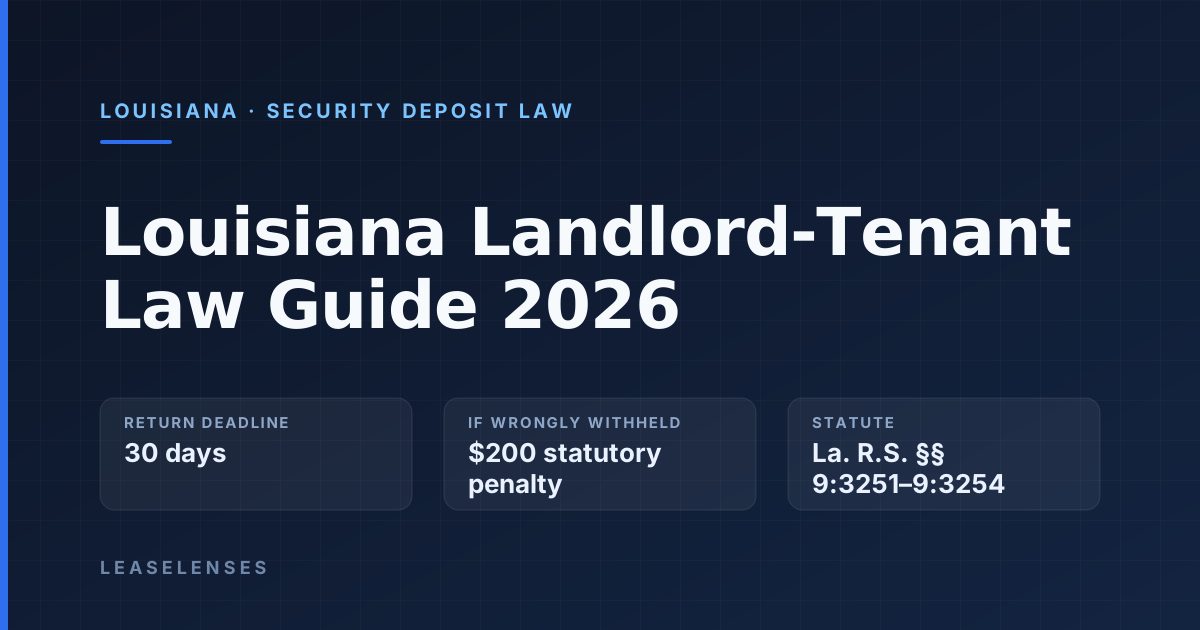
Understanding Louisiana landlord-tenant law requires reading the lease and the Civil Code together. Louisiana does not use the same common-law framework many other states use, so a generic "tenant rights" checklist can miss the clauses that actually decide a dispute.
For a residential lease in New Orleans, Baton Rouge, Shreveport, Lafayette, or elsewhere in Louisiana, the practical lease-review questions are usually concrete: how the security deposit can be withheld, whether the landlord can delay the itemized statement after August 1, 2026, what repair promises were actually made, whether the tenant waived the five-day notice to vacate, and what notice is required before a month-to-month lease ends.
Source note: this guide is based on Louisiana Revised Statutes §§9:3251 and 9:3252, 2026 Act 63 / HB292, Louisiana Civil Code articles 2682, 2683, 2684, 2691, 2694, 2728, and 2729, and Louisiana Code of Civil Procedure article 4701. It is general information, not legal advice.
Upload your Louisiana lease to LeaseLenses and check the exact clauses on deposit deductions, Act 63 timing, repair demands, entry, renewal, and article 4701 notice waiver before you sign, enforce, or pay.
Overview of Louisiana Landlord-Tenant Law
Louisiana lease law is built around the relationship between the lessor and the lessee. Louisiana Civil Code article 2668 defines lease as a contract where one party gives another the use and enjoyment of a thing for a term in exchange for rent.
Key Louisiana Lease Review Points
- Louisiana has no statewide statutory cap on residential security deposit amounts.
- Current R.S. §9:3251 requires return of the deposit or an itemized retained-deposit statement within one month after the lease terminates, subject to exceptions.
- 2026 Act 63, effective August 1, 2026, changes the retained-deposit itemization timing in R.S. §9:3251(A).
- Civil Code repair rights depend on demand, necessity, reasonableness, and lease language.
- Article 4701's five-day notice to vacate can be waived by written waiver in the lease.
- Month-to-month termination under Civil Code article 2728 uses 10 calendar days before the end of the month, unless the lease requires more.
For a deeper look at lease disclosures, see our landlord disclosure requirements guide.
Louisiana Security Deposit Law
Security deposit disputes are common in Louisiana because the statute is short, but the lease often adds detailed deductions, cleaning charges, early-move-out fees, and forwarding-address requirements.
No Statutory Deposit Cap
Louisiana does not impose a statewide statutory limit on the amount a landlord may collect as a residential security deposit. Many leases use one month's rent, but the statute does not create a one-month or two-month cap.
That does not mean every upfront charge is harmless. A lease should clearly distinguish:
- Refundable security deposit
- Nonrefundable application, administrative, cleaning, or pet fees
- Prepaid rent
- Charges that are due only after a documented default
If a fee is refundable in substance but the lease labels it another way, that is a clause worth reviewing before signing.
Current One-Month Return Rule
Under current Louisiana R.S. §9:3251(A), money furnished by a tenant or lessee as security for a written or oral residential lease must be returned within one month after the lease terminates. If the landlord retains any portion, the landlord must send an itemized statement explaining the retained amounts within that same one-month period.
The tenant should provide a forwarding address at the termination of the lease because the statute directs statements to that address. The landlord may retain amounts reasonably necessary to remedy a tenant default or unreasonable wear to the premises.
Important lease-review point: "one month" is the statutory phrase. A lease or article that translates this into a flat "30 days" may be close in ordinary conversation, but the lease should match the statute when timing matters.
Act 63 Effective August 1, 2026
Louisiana 2026 Act 63, also known as HB292, was signed by the Governor and has an effective date of August 1, 2026. It amends R.S. §9:3251(A) for retained security deposits.
The Act changes the itemized-statement sentence so that, when a landlord retains any part of the deposit, the itemized accounting may be sent within one month after the tenancy terminates or within fifteen days after the date that is one month after the tenancy terminates.
Practical lease review point: a Louisiana lease used in the second half of 2026 should not rely on an old security-deposit clause without checking whether the Act 63 timing language has been incorporated correctly.
Abandonment Exception
R.S. §9:3251(A)'s return-and-itemization rule does not apply when the tenant abandons the premises without giving required notice or before the lease terminates. Because abandonment can be disputed, leases should define notice, surrender, keys, utilities, and move-out communication carefully.
Consequences of Wrongful Withholding
Under Louisiana R.S. §9:3252, willful failure to comply with R.S. §9:3251 allows the tenant to recover the wrongfully retained portion plus $300 or twice the wrongfully retained amount, whichever is greater. Failure to remit within 30 days after written demand for a refund constitutes willful failure.
That penalty is another reason a lease should not use vague deductions such as "general cleaning," "turnover," "administration," or "processing" without tying the charge to actual default, unreasonable wear, invoices, photos, and the written lease.
Repairs and Habitability in Louisiana
Louisiana does not use a modern Uniform Residential Landlord and Tenant Act, but the Civil Code still gives important repair rights.
Lessor Obligations
Louisiana Civil Code article 2682 says the lessor is bound to deliver the thing to the lessee, maintain it in a condition suitable for the purpose for which it was leased, and protect the lessee's peaceful possession. Article 2684 separately requires delivery at the agreed time and in good condition suitable for the lease purpose.
During the lease, Civil Code article 2691 requires the lessor to make repairs necessary to maintain the premises in a suitable condition, except repairs for which the lessee is responsible.
Lessee Obligations
Civil Code article 2683 requires the lessee to pay rent as agreed, use the property as a prudent administrator and for the agreed purpose, and return it at the end in the same condition except for normal wear and tear or as otherwise provided.
That means a lease review should look for both sides of the repair allocation:
- Which repairs are the landlord's obligation
- Which minor or tenant-caused repairs are shifted to the tenant
- Whether the lease tries to make the tenant responsible for preexisting defects
- Whether repair notice must be sent by certified mail, portal, email, or another method
- Whether the lease has an "as is" or waiver clause that should be reviewed before signing
Repair and Deduct Under Article 2694
Civil Code article 2694 gives a careful repair-and-deduct path. If the lessor fails to make necessary repairs within a reasonable time after demand by the lessee, the lessee may cause the repairs to be made and demand reimbursement or apply the amount to rent, but only to the extent the repair was necessary and the cost was reasonable.
This is not the same as freely withholding rent whenever the tenant is unhappy with conditions. Before relying on article 2694, the tenant should preserve written demand, photos, estimates, receipts, and proof that the repair was necessary.
Free check · no account, no card
Check this against your own lease
This guide covers Louisiana's rules. The free check tells you which ones your lease actually meets, misses, or waives. Paste the clause here and keep reading — the verdict appears on this page.
Skip full upload for now
Paste one clause and get the first free verdict.
Use the exact wording about deposit, repairs, entry, notice, renewal, fees, waiver, or move-out. We keep this article's state-law context, show a free clause verdict first, and ask for payment only if the Action Packet is useful.
What the free verdict includes
Free verdict includes
What to paste
Paid packet adds
Exact clause proof · Preferred, fallback, and minimum wording · Likely reply, evidence to keep, deadline radar, and PDF export
Have the lease open?
Copy 2-6 sentences from the clause into the box. No file or card is needed for the first verdict.
Entry Rights in Louisiana
Louisiana does not have a simple statewide statute that says every private residential landlord must give exactly 24 hours' notice before entry.
Instead, entry rights should be reviewed through the lease and the lessor's duty to protect peaceful possession. A clear entry clause should state:
- How notice will be given
- How far in advance ordinary non-emergency entry will be noticed
- The purposes for entry, such as repairs, inspection, pest treatment, showings, or emergency response
- Reasonable hours for non-emergency entry
- What counts as an emergency
If a Louisiana lease says the landlord may enter "at any time" for broad reasons, that is not a clause to skim past.
Eviction and Notice to Vacate in Louisiana
Louisiana eviction procedure depends heavily on the lease and on Louisiana Code of Civil Procedure article 4701.
Article 4701 Five-Day Notice to Vacate
When a lessee's right of occupancy has ceased because of lease expiration, action by the lessor, nonpayment of rent, or another reason, article 4701 requires written notice to vacate before the landlord seeks possession. The notice must allow the lessee not less than five days from delivery to vacate.
This is often described online as a "5-day eviction notice," but the lease-review detail is more precise: it is a notice to vacate, not necessarily a cure notice or a pay-or-vacate notice.
Written Waiver of the Five-Day Notice
Article 4701 allows the lessee to waive the notice requirement by written waiver contained in the lease. If the waiver applies and the right of occupancy has terminated, the lessor may immediately institute eviction proceedings under the Code of Civil Procedure.
That waiver is one of the highest-value Louisiana lease clauses to flag. A tenant may assume they will get five days before court, while the signed lease may have waived that notice.
Fixed-Term and Month-to-Month Rules
For a lease with no definite term, the notice required by law for termination is treated as the notice to vacate under article 4701. For a definite-term lease, notice to vacate may be given not more than 30 days before the end of the term.
Civil Code article 2728 sets termination timing for indeterminate leases. For a month-to-month lease, notice must be given 10 calendar days before the end of that month. Article 2729 requires the notice of termination to be written when the leased thing is immovable or a movable used as a residence.
Court Process, Not Lockouts
After notice, the landlord must use the court process to obtain possession. Changing locks, removing belongings, shutting off utilities, or physically excluding a tenant without court process creates wrongful-eviction risk and can turn a rent dispute into a damages dispute.
Rent Increases and Renewal Clauses
Louisiana does not have a statewide rent-control system for ordinary private residential leases. The key lease-review question is usually not a separate rent-increase statute, but what the lease says about renewal, reconduction, month-to-month conversion, and required notice.
Review these clauses carefully:
- Automatic renewal or reconduction language
- Notice required to avoid renewal
- Rent increase notice before a renewal or month-to-month period
- Month-to-month termination language
- Fees for moving out without the contractually required notice
If the lease requires more notice than the Civil Code baseline, the lease language may control in practice.
How LeaseLenses Helps Review Louisiana Leases
Louisiana lease disputes often turn on clauses a reader might skip: security deposit deductions, Act 63 timing, repair demand procedure, entry language, reconduction, and article 4701 notice waivers.
LeaseLenses reviews the lease text in front of you and flags clauses worth checking, including:
- Deposit clauses that still use outdated one-month itemization language after Act 63
- Deductions that treat ordinary turnover as automatic tenant damage
- Repair clauses that conflict with Civil Code articles 2682, 2691, or 2694
- Entry clauses that fail to define notice, purpose, hours, and emergency access
- Eviction clauses that waive article 4701's five-day notice to vacate
- Renewal clauses that create unexpected month-to-month, fee, or rent-increase exposure
If you found this guide because you searched "Louisiana landlord tenant law" or "Louisiana security deposit law," the next useful step is checking the actual lease.
Upload your Louisiana lease to LeaseLenses and review deposit, repair, entry, renewal, and eviction-notice clauses before you sign, enforce, or pay.
Frequently Asked Questions
Q: Is there a limit on how much a landlord can charge for a security deposit in Louisiana?
A: No. Louisiana does not impose a statewide statutory cap on residential security deposit amounts. The lease should still clearly distinguish refundable deposits from nonrefundable fees and prepaid rent.
Q: How long does a Louisiana landlord have to return a security deposit?
A: Current R.S. §9:3251 uses a one-month deadline after the lease terminates. If the landlord retains any portion, the landlord must provide an itemized statement. Act 63, effective August 1, 2026, changes the retained-deposit itemization timing.
Q: What penalty applies if a landlord wrongfully keeps a Louisiana deposit?
A: Under R.S. §9:3252, willful failure to comply can allow recovery of the wrongfully retained amount plus $300 or twice the wrongfully retained amount, whichever is greater. Failure to remit within 30 days after written demand counts as willful failure.
Q: Can a Louisiana tenant repair and deduct from rent?
A: Article 2694 allows repair and deduct only after the lessor fails to make necessary repairs within a reasonable time after demand, and only for necessary and reasonable repair costs. Documentation matters.
Q: Does a Louisiana landlord always have to give five days before eviction court?
A: Article 4701 generally requires a notice to vacate allowing at least five days from delivery, but the lessee may waive that notice requirement in a written lease. That waiver clause should be checked carefully.
Q: How much notice is required to end a month-to-month lease in Louisiana?
A: Civil Code article 2728 requires 10 calendar days before the end of the month for a month-to-month lease, and article 2729 requires written notice for immovable property or a residence. The lease may require more notice.
Conclusion: Navigating Louisiana Landlord-Tenant Law in 2026
Louisiana landlord-tenant law is lease-driven, Civil Code-driven, and unusually sensitive to waiver language. A short clause can change the practical result.
Key takeaways for 2026:
- No statewide security deposit cap
- Current deposit return timing is one month, with Act 63 changes effective August 1, 2026
- Wrongful deposit withholding can trigger $300 or 2x the wrongfully retained amount
- Repair-and-deduct requires demand, necessity, reasonableness, and documentation
- Article 4701's five-day notice to vacate can be waived in writing
- Month-to-month termination uses 10 calendar days before the end of the month unless the lease requires more
Ready to check the lease instead of guessing from a generic summary? Upload your Louisiana lease to LeaseLenses and review the clauses most likely to affect your deposit, repairs, entry rights, renewal, and eviction exposure.
Turn this guide into your lease gap checklist
Check whether your Louisiana lease waives notice or mishandles deposit, repair, and renewal clauses
Choose the PDF or Word lease first and preview deposit, Act 63 timing, repair-demand, renewal, and notice-waiver risks before paying.
The free check runs first — no credit card. You only ever pay if the findings are worth keeping.
Money, repair, notice, and move-out clauses to verify
A state guide explains the rule; a lease scan shows whether the document you are about to sign gives you a money, deadline, or rights problem.
- Security deposit, late fee, entry notice, and repair duties
- Missing disclosures, waiver language, and one-sided penalties
- State compliance warnings with copy-ready next steps to send or keep
Want the Louisiana deadline emailed to you on the day it lands?
Tell us the day you moved out. We count the 30 days La. R.S. §§ 9:3251–9:3254 allows and email you once, on the day the landlord runs out of time — with what you can do next.
No newsletter, no account. Your address is used for this one email.
Ready to compare this Louisiana guide with your lease?
Sign in once, then choose your lease. The free preview shows whether deposit, Act 63, repair-demand, renewal, or notice-waiver language deserves attention; unlock the action packet from $9.99 only if it helps.