Arkansas Landlord-Tenant Law 2026: Act 1052 & Tenant Rights
Reading this because of your own Arkansas lease?
Upload it and the AI checks it against Arkansas rules in about 2 minutes — free, no credit card.
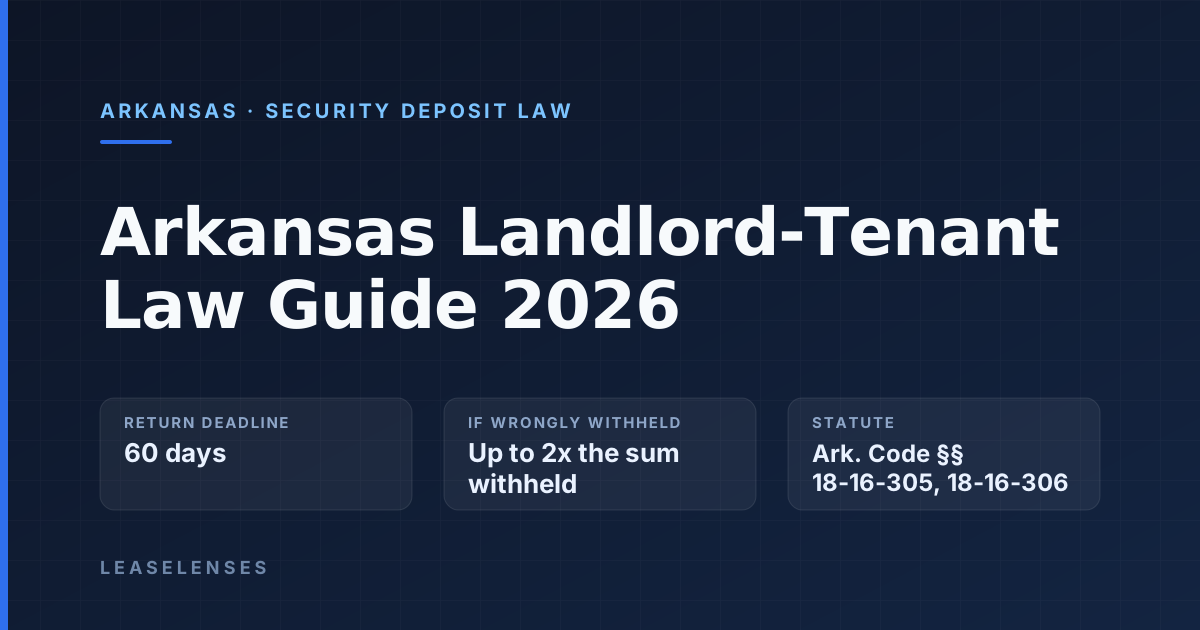
Understanding Arkansas landlord-tenant law is especially important before signing or enforcing a residential lease because Arkansas is more lease-driven than many states. The clauses that usually matter most are security deposits, repair promises, minimum quality standards, entry language, rent-change notice, and eviction procedure language.
Arkansas rental law is spread across several parts of Title 18. Security deposit rules appear in Arkansas Code §§18-16-301 through 18-16-306. Residential landlord-tenant remedies and minimum quality standards appear in the Arkansas Residential Landlord-Tenant Act of 2007, including §18-17-502 and §18-17-901. Civil unlawful detainer rules appear in §§18-60-301 through 18-60-312.
This guide focuses on the 2026 issues worth checking in the lease itself: whether the two-month deposit cap actually applies to the landlord, whether the 60-day deposit-return clause is written correctly, whether the lease tries to waive Act 1052's minimum quality standards, and whether the eviction section mixes up civil eviction, unlawful detainer, and criminal failure-to-vacate language.
If you are reading this before signing or renewing, the most useful next step is to compare these rules against your actual lease text. Upload your Arkansas lease to LeaseLenses to get a free preview of deposit, repair, entry, renewal, and eviction clauses before paying for the full clause-by-clause report.
Overview of Arkansas Landlord-Tenant Law
Arkansas is still considered landlord-friendly compared with many states, but the current law is more nuanced than older "as is" summaries suggest. Since 2021, Arkansas Code §18-17-502 implies limited residential quality standards into new and renewed residential leases, while still giving tenants a narrower remedy than many other states.
Source note: this page is based on the Arkansas Attorney General's landlord/tenant summary, Arkansas Code §§18-16-101, 18-16-303 through 18-16-306, 18-17-502, 18-17-701, 18-17-901, 18-60-304, and 18-60-307. It is general information, not legal advice.
Key Arkansas Lease Review Points
- The security deposit cap does not apply to every small self-managed landlord.
- Covered landlords must return the deposit or itemized deductions within 60 days.
- Leases entered into or renewed after November 1, 2021 include limited minimum quality standards.
- Tenants generally cannot withhold rent or repair-and-deduct for alleged quality-standard violations.
- Arkansas has multiple eviction paths, so notice language should match the path being used.
For additional details on landlord disclosure obligations, see our landlord disclosure requirements guide.
Arkansas Security Deposit Law
Security deposit rules in Arkansas are found in Arkansas Code §§18-16-301 through 18-16-306. This is one of the places where generic summaries often overstate the rule.
When the Deposit Statute Applies
Arkansas's security deposit subchapter generally does not apply to dwelling units owned by an individual if that person, their spouse and minor children, and related rental entities collectively own five or fewer dwelling units. That exemption does not apply when management, including rent collection, is performed by a third party for a fee.
Practical lease review point: before deciding whether the two-month cap applies, ask who owns the rental units and whether a paid property manager collects rent or manages the property.
Security Deposit Limit: Two Months' Rent for Covered Landlords
For landlords covered by the security deposit subchapter, Arkansas Code §18-16-304 caps the security deposit at two months' periodic rent. This includes refundable amounts that function as a security deposit, even if the lease labels them as a pet deposit, cleaning deposit, or damage deposit.
For a tenant paying $1,000 per month, a covered landlord generally should not demand more than $2,000 as a refundable security deposit. Nonrefundable fees are a separate lease-review issue and should be clearly labeled.
The 60-Day Return Rule
Under Arkansas Code §18-16-305, the landlord must return money or property held as security within 60 days after termination of the tenancy. If the landlord withholds money for unpaid rent or damages caused by the tenant's noncompliance with the rental agreement, the landlord must itemize the withholding in a written notice and return the remaining amount within that same 60-day period after termination and delivery of possession.
The landlord is deemed to comply by mailing the written notice and payment to the tenant's last known address by first class mail. If the letter containing payment is returned and the landlord cannot locate the tenant after reasonable effort, the payment may become the landlord's property 180 days after the mailing date.
Permitted Deductions
Arkansas landlords may deduct from the security deposit for:
- Accrued unpaid rent - rent owed under the lease
- Damages from tenant noncompliance - costs tied to violation of the rental agreement
- Damage beyond ordinary use - repair costs supported by photos, invoices, and move-in records
- Other amounts due under the lease - only where the lease and applicable law support the charge
The lease should not turn ordinary wear, vague cleaning, or normal turnover costs into automatic deposit deductions. Deductions are strongest when supported by a move-in condition report, dated photos, invoices, and an itemized explanation.
Consequences of Non-Compliance
Under Arkansas Code §18-16-306, if a landlord fails to comply with the security deposit subchapter, the tenant may recover the money due, damages equal to two times the amount wrongfully withheld, costs, and reasonable attorney's fees. The statute also creates a narrower outcome where the landlord proves the problem came from a reasonable-procedure error or a good-faith dispute over the amount due.
Quality Standards and Repairs in Arkansas
Act 1052 and the 2021 Quality Standards
Older Arkansas summaries often say tenants rent "as is." That is incomplete for current residential leases. For residential lease agreements entered into or renewed after November 1, 2021, Arkansas Code §18-17-502 implies certain minimum quality standards into the lease.
The dwelling unit or single-family residence must have:
- Hot and cold running water
- Electricity
- Potable drinking water
- A sanitary sewer system and plumbing that conform to applicable codes at installation
- A functioning roof and building envelope
- Heating and air conditioning to the extent those systems served the premises when the lease began
Unless the tenant agrees in writing to take responsibility for renovation, remodeling, or completion of construction, these standards supersede contrary lease language.
Tenant Notice and Remedy
If the property does not meet the listed quality standards, the tenant must send written notice by certified mail or another method allowed by the lease. The notice should identify the acts or omissions that create the noncompliance.
If rent is current, the noncompliance is not excused by the tenant's own conduct, and the landlord does not remedy the problem within 30 calendar days after receiving the notice, the tenant's sole statutory remedy under §18-17-502 is to terminate the lease without penalty and receive any recoverable security deposit.
Important lease-review point: Arkansas tenants generally may not withhold or offset rent for alleged quality-standard violations under §18-17-502. Lease language promising broader repair rights, local housing code remedies, subsidized-housing rules, or separate written repair promises may change the practical analysis.
Move-In Defect Forms
Arkansas Code §18-17-502 also gives landlords a compliance pathway if they provide a written form for listing defects when possession is available. If the tenant signs without noting defects or fails to return the form within two business days, that can matter later. Tenants and landlords should preserve that form and any move-in photos.
Entry Rights in Arkansas
Arkansas does not have a broad statewide statute that sets a universal 24-hour landlord-entry notice period for ordinary private residential rentals. The lease should therefore define entry rights carefully.
What a Clear Entry Clause Should Say
A practical Arkansas entry clause should state:
- How much advance notice the landlord or manager will provide
- Whether notice may be by email, text, portal message, posting, or mail
- The purposes for entry, such as inspection, repair, showings, pest treatment, or emergency response
- The normal hours for non-emergency entry
- What counts as an emergency
If the lease says "landlord may enter at any time," that is a clause worth reviewing before signing. If the lease promises 24 hours' notice, the landlord should follow the lease promise even though Arkansas does not use a simple statewide 24-hour statute for all rentals.
Free check · no account, no card
Check this against your own lease
This guide covers Arkansas's rules. The free check tells you which ones your lease actually meets, misses, or waives. Paste the clause here and keep reading — the verdict appears on this page.
Skip full upload for now
Paste one clause and get the first free verdict.
Use the exact wording about deposit, repairs, entry, notice, renewal, fees, waiver, or move-out. We keep this article's state-law context, show a free clause verdict first, and ask for payment only if the Action Packet is useful.
What the free verdict includes
Free verdict includes
What to paste
Paid packet adds
Exact clause proof · Preferred, fallback, and minimum wording · Likely reply, evidence to keep, deadline radar, and PDF export
Have the lease open?
Copy 2-6 sentences from the clause into the box. No file or card is needed for the first verdict.
Eviction Process in Arkansas
Arkansas has several eviction-related statutes, and lease templates often confuse them. The main civil paths are eviction proceedings under the Residential Landlord-Tenant Act and unlawful detainer under Title 18, Chapter 60. Arkansas also has a separate criminal failure-to-vacate statute for nonpayment situations.
Civil Eviction Under §18-17-901
Under Arkansas Code §18-17-901, a landlord may commence eviction proceedings in district court when:
- The tenant fails or refuses to pay rent when due or when demanded
- The tenancy or occupancy term has ended
- The tenant violates the rental agreement
For residential rental agreements, nonpayment of rent within five days of the date due constitutes legal notice that the landlord has the right to begin eviction proceedings under that chapter.
Unlawful Detainer and the Three-Day Written Notice
Under Arkansas Code §18-60-304, a tenant may be in unlawful detainer if they fail or refuse to pay rent when due and, after three days' written notice to quit and written demand for possession, refuse to leave. The Arkansas Attorney General also summarizes unlawful detainer as requiring three days' written notice to vacate before the landlord sues.
Practical lease review point: if a lease says "3 days," confirm whether it is describing unlawful detainer under §18-60-304, a separate lease cure period, or a different eviction route. These should not be blurred together.
The Five-Day Objection Window
After an unlawful detainer complaint, summons, and notice seeking a writ of possession are served, Arkansas Code §18-60-307 gives the tenant five days, excluding Sundays and legal holidays, to file a written objection to the claim for possession. If no written objection is filed, the court may issue a writ of possession. If an objection is filed, a hearing follows.
Fourteen-Day Cure Notice for Lease Violations
For non-rent tenant noncompliance under Arkansas Code §18-17-701, the landlord may deliver written notice specifying the acts or omissions and stating that the rental agreement will terminate on a date at least 14 days after receipt if the noncompliance is not remedied. Nonpayment has a separate five-day rule under §18-17-701(b).
Criminal Failure to Vacate
Arkansas Code §18-16-101 is unusual. If rent is not paid when due, and after 10 days' written notice the tenant willfully refuses to vacate, the statute makes the refusal a misdemeanor and allows a fine between $1 and $25 for each offense, with each day after expiration of the notice potentially treated separately.
Because the civil and criminal routes have different consequences, a lease or notice should not use vague wording that makes a tenant think every late-rent issue is the same procedure.
Self-Help Evictions
Landlords should use the court process rather than changing locks, removing belongings, shutting off utilities, or physically excluding a tenant. The Arkansas Attorney General describes unlawful detainer as a court action, and court procedure matters for both sides.
Rent Changes and Lease Termination
The Arkansas Attorney General states that landlords must provide at least one rental period's notice before raising rent, and that this rule applies to oral and written leases. Written leases may include their own renewal, nonrenewal, and rent-change procedures, so those clauses should be read carefully.
For tenants planning to move:
- A written lease usually controls the notice required to move out or avoid renewal.
- For an oral lease, the Attorney General summarizes the notice as one rental period.
- A fixed-term lease generally should not have rent increased mid-term unless the lease allows it.
Fair Housing and Protected Housing
Arkansas's general private rental rules are limited, but federal fair housing law still applies. The Fair Housing Act prohibits discrimination in most residential rental transactions based on protected characteristics such as race, color, religion, sex, disability, familial status, and national origin.
Government-subsidized housing, local housing codes, lead-hazard rules, and written lease promises may add protections beyond the general private-rental summary.
How LeaseLenses Helps Review Arkansas Leases
Arkansas lease disputes often start with clauses that look routine: broad entry permission, automatic cleaning charges, deposit language that ignores the five-unit exemption, vague repair promises, or eviction language copied from the wrong Arkansas procedure.
LeaseLenses reviews the lease language in front of you and flags clauses worth checking, including:
- Deposit clauses that claim a two-month cap without confirming whether the statute applies
- Deposit-return clauses that omit the 60-day written itemization rule
- Repair clauses that conflict with §18-17-502's minimum quality standards
- Entry clauses that allow access without defined notice, purpose, or emergency limits
- Eviction clauses that mix 3-day unlawful detainer, 5-day civil eviction, 5-day objection, and 10-day criminal failure-to-vacate language
If you found this guide because you searched "Arkansas landlord tenant law" or "Arkansas security deposit law," the next useful step is checking the actual lease.
Upload your Arkansas lease to LeaseLenses and review deposit, repair, entry, renewal, and eviction language before you sign, enforce, or pay.
Frequently Asked Questions
Q: What is the maximum security deposit a landlord can charge in Arkansas?
A: For landlords covered by Arkansas Code §18-16-304, the maximum security deposit is two months' periodic rent. But Arkansas Code §18-16-303 exempts certain small self-managed landlords who collectively own five or fewer dwelling units, unless third-party management or rent collection is involved.
Q: How long does my Arkansas landlord have to return my security deposit?
A: Under Arkansas Code §18-16-305, covered landlords must return the deposit or provide written itemized deductions within 60 days after termination of the tenancy and delivery of possession by the tenant.
Q: Does Arkansas require landlords to maintain habitable conditions?
A: For residential leases entered into or renewed after November 1, 2021, Arkansas Code §18-17-502 implies limited quality standards such as running water, electricity, potable water, sanitary sewer/plumbing, a functioning roof/envelope, and served HVAC systems. The tenant's statutory remedy is narrower than in many states and generally does not include rent withholding.
Q: How much notice is required before eviction in Arkansas?
A: It depends on the procedure. Section 18-17-901 treats nonpayment within five days of the due date as legal notice for eviction proceedings under that chapter. Unlawful detainer under §18-60-304 uses a three-day written notice to quit and demand for possession. After an unlawful detainer summons, complaint, and notice are served, §18-60-307 gives the tenant five days, excluding Sundays and legal holidays, to file a written objection.
Q: Can a tenant face criminal charges for not vacating in Arkansas?
A: Yes. Arkansas Code §18-16-101 still includes a criminal failure-to-vacate path for nonpayment situations after 10 days' written notice. That route is separate from civil eviction and unlawful detainer.
Conclusion: Navigating Arkansas Landlord-Tenant Law in 2026
Arkansas landlord-tenant law is not just a simple "landlord-friendly" checklist. The lease must be read against the correct statute and procedure.
Key takeaways for 2026:
- Security deposit rules have an important small-landlord exemption
- Covered deposits are capped at two months' rent and returned or itemized within 60 days
- Act 1052 created limited minimum quality standards for new and renewed residential leases
- Tenants generally cannot withhold rent for alleged quality-standard violations
- Arkansas eviction language must distinguish civil eviction, unlawful detainer, and criminal failure to vacate
- Entry and renewal clauses deserve close review because Arkansas relies heavily on lease language
Ready to check the lease instead of guessing from a generic checklist? Upload your Arkansas lease to LeaseLenses and review the clauses most likely to affect your deposit, repairs, entry rights, renewal, and eviction exposure.
Turn this guide into your lease gap checklist
Check whether your Arkansas lease handles deposit, repair, and eviction clauses correctly
Upload the lease and preview deposit-return, repair, entry, and notice/default risks before paying.
The free check runs first — no credit card. You only ever pay if the findings are worth keeping.
Money, repair, notice, and move-out clauses to verify
A state guide explains the rule; a lease scan shows whether the document you are about to sign gives you a money, deadline, or rights problem.
- Security deposit, late fee, entry notice, and repair duties
- Missing disclosures, waiver language, and one-sided penalties
- State compliance warnings with copy-ready next steps to send or keep
Want the Arkansas deadline emailed to you on the day it lands?
Tell us the day you moved out. We count the 60 days Ark. Code §§ 18-16-305, 18-16-306 allows and email you once, on the day the landlord runs out of time — with what you can do next.
No newsletter, no account. Your address is used for this one email.
Ready to compare this Arkansas guide with your lease?
Sign in once, then choose your lease. The free preview shows whether deposit, repair, entry, notice, or default language deserves attention; unlock the action packet from $9.99 only if it helps.